
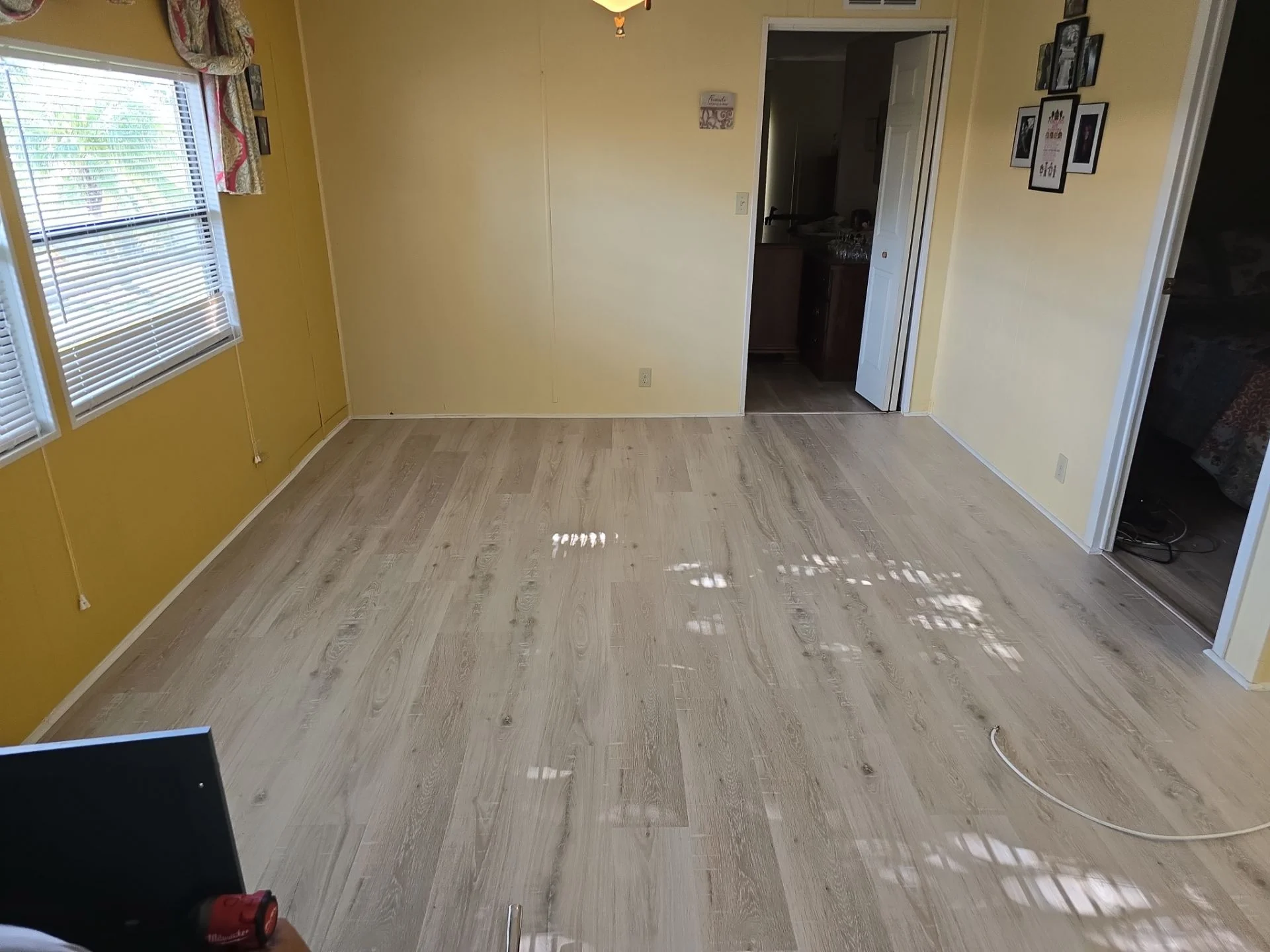
Look under most older manufactured homes in Florida and you find the same thing holding the floor up. It is particleboard, chosen because it was cheap and flat, not because it lasts. A particleboard mobile home subfloor can serve for years, right up until moisture finds it.
Once that happens, the difference between particleboard and plywood stops being a technical detail. It becomes the reason your floor feels solid or the reason it does not.
What a Particleboard Mobile Home Subfloor Actually Is
Particleboard is made from wood chips and sawdust pressed together with glue and heat. It comes out smooth, even, and inexpensive, which is why manufacturers reached for it for decades. Plywood is built differently. It uses thin layers of real wood veneer glued in alternating directions, which gives it strength and a better tolerance for moisture.
Both materials sit in the same place, the structural decking between your flooring and the frame. In dry conditions, both hold up fine. The gap between them only appears once water enters the picture.
Why Particleboard Fails First in Florida
Florida is about the hardest place you can ask particleboard to survive. The humidity never really lets up, and the rainy season keeps the ground under the home damp for weeks at a time.
When particleboard takes on moisture, it swells and the glue bond breaks down. The chips separate, the sheet loses its structure, and it crumbles rather than simply warping. That is why a soft spot in a particleboard floor tends to grow. The material does not hold a line, so once one area goes, the moisture keeps working into the next.
How Plywood Behaves Differently
Plywood is not waterproof, but it handles moisture with more grace. Its layered structure lets it dry out and often keep much of its strength.
When plywood does fail, it usually fails in a more contained way. The damage stays closer to the source instead of racing across the room. This is why we rebuild with proper, moisture-rated decking rather than replacing like for like with the same bargain particleboard that failed.
Where Particleboard Damage Tends to Start
Some spots take the hit before others, and they are worth knowing. Bathrooms lead the list, since they combine plumbing, splashing, and steam in one small room.
Kitchens follow close behind. Areas near exterior doors and slider tracks are common too, because wind-driven rain finds its way in over time.
If the floor feels worst in these places, moisture is almost certainly the driver, and particleboard is almost certainly what is giving way underneath.
How to Tell Which One You Have
You do not need to crawl under the home to get a strong hint. The way the floor behaves tells you a lot.
A floor that feels soft and spongy, then spreads over a season, points to failing particleboard. A floor with one damaged patch near a known leak that stayed put is more likely plywood.
Age is another clue, since older homes almost always shipped with particleboard. If you have already noticed soft areas in the floor, the material below is worth confirming, and our flooring and subfloor answers cover more of what homeowners ask.
Why You Cannot Just Swap the Surface
When a particleboard subfloor fails, laying new flooring over it changes nothing structural. The decking below keeps breaking apart, and the new surface only hides it for a while.
Within a season or two, the softness returns, and now the new flooring has to come up too. The only lasting fix is to remove the failed decking and rebuild what is under it.
You can see what that rebuild involves on our completed floor projects, where crumbling particleboard was replaced with decking built to last.
Stopping the Moisture, Not Just the Symptom
New decking will fail the same way if the water source stays in place. That is the step people skip in a hurry to move on.
A slow plumbing leak, a torn barrier under the home, or humidity rising through the belly all keep the floor wet. Before any new subfloor goes down, the source has to be found and corrected.
Often that means checking and repairing the under-home vapor barrier while the floor is open. Homeowners dealing with rotted floor decking almost always have a moisture problem feeding it.
Partial Repair or Full Replacement
Not every floor needs to come out wall to wall. If the damage is caught early and stays in one area, a contained repair can be enough.
The trouble with particleboard is that it rarely stays contained. Waiting turns a single-room fix into a larger one, so the earlier it is looked at, the smaller the job tends to be.
An inspection settles the question. It shows how far the damage runs, which decides whether a section or the whole floor needs replacing.
What a Proper Subfloor Rebuild Looks Like
A real repair starts by finding where the moisture came from. From there, the failed particleboard comes out completely, not just the softest patch.
Fresh, properly rated decking goes in, the area is leveled, and the floor is secured so no bounce is left behind. New flooring goes down last, over a floor that finally feels firm.
Done this way, the repair fixes the material problem at the root. The floor is no longer relying on particleboard that was never built for Florida, which is the core of our mobile home flooring and subfloor work.
Get the Material Under Your Floor Checked
If your floor feels soft, keeps spreading, or you simply want to know what is holding it up, a look underneath answers it quickly. Knowing whether you have particleboard or plywood shapes the right repair.
Reach out through our contact page to schedule a free inspection, and we will tell you plainly what is under your floor and what it needs.